Your therapist sees you for 50 minutes a week. Lisner preserves the other 167.
Because sometimes you just need someone to listen. That's it.
The unfiltered weight of a 2am moment. The post-argument clarity that's gone by Friday. Reconstructed from memory, under observation, in a cognitive state nothing like when the insight occurred.
Therapy is powerful. But it runs on a 50-minute sample of a 10,080-minute week. Lisner captures the other 9,960 — not by tracking you, but by giving your own words a place to land.
"I cancelled again today. Third time with the same friend. I keep telling myself I'll feel more like it next week and I'm starting to think next week is just a story I tell myself."
How it works
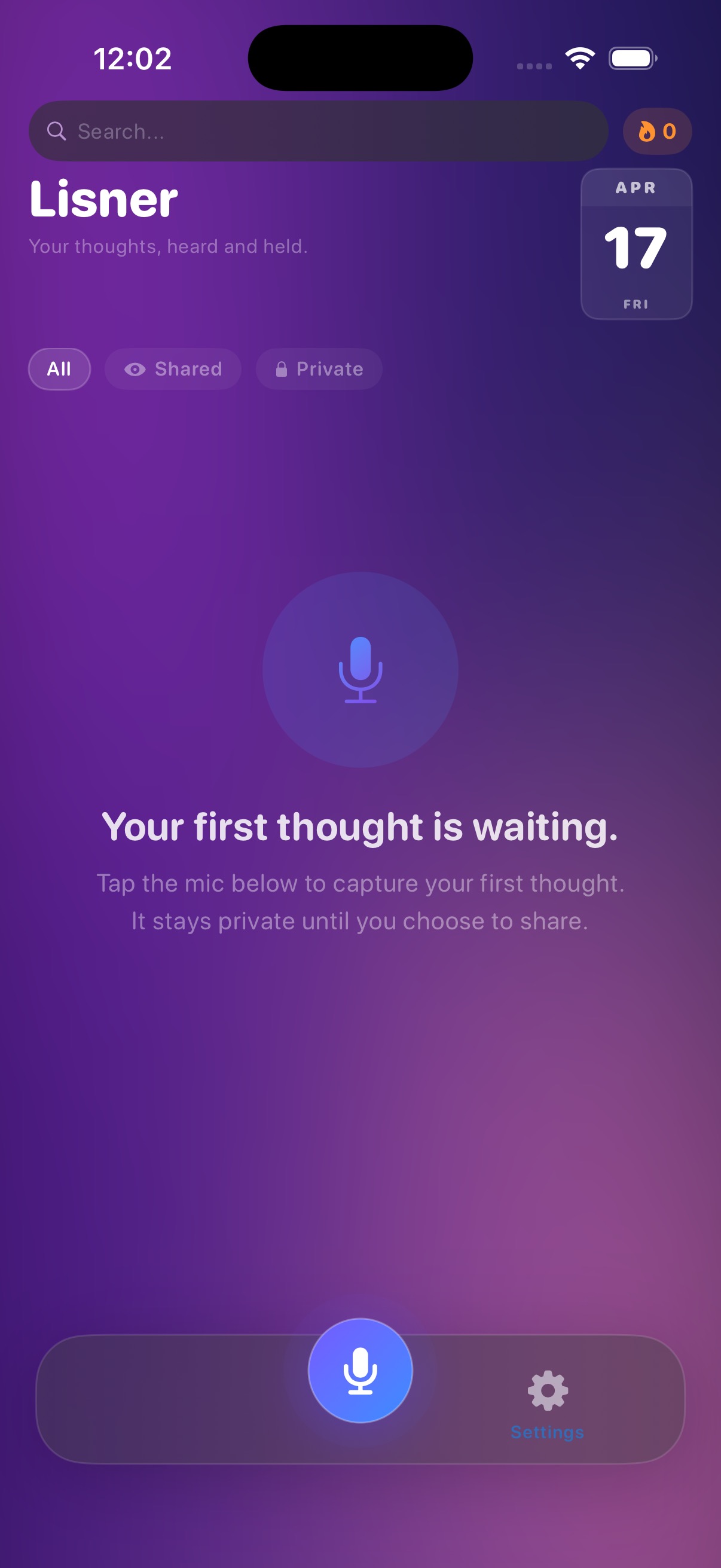
One tap. Say what's on your mind. Your words stay private — nothing is ever sent to a server without your choice.
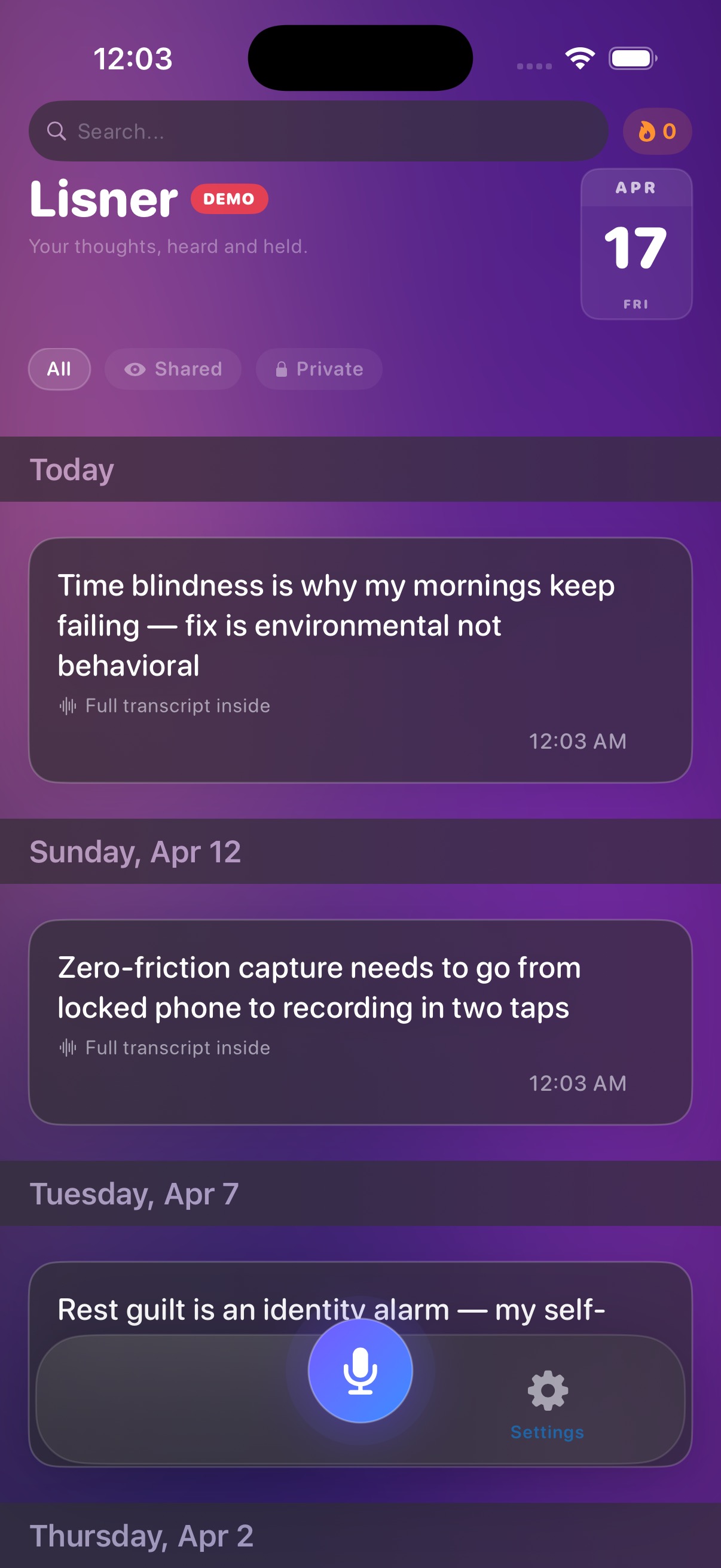
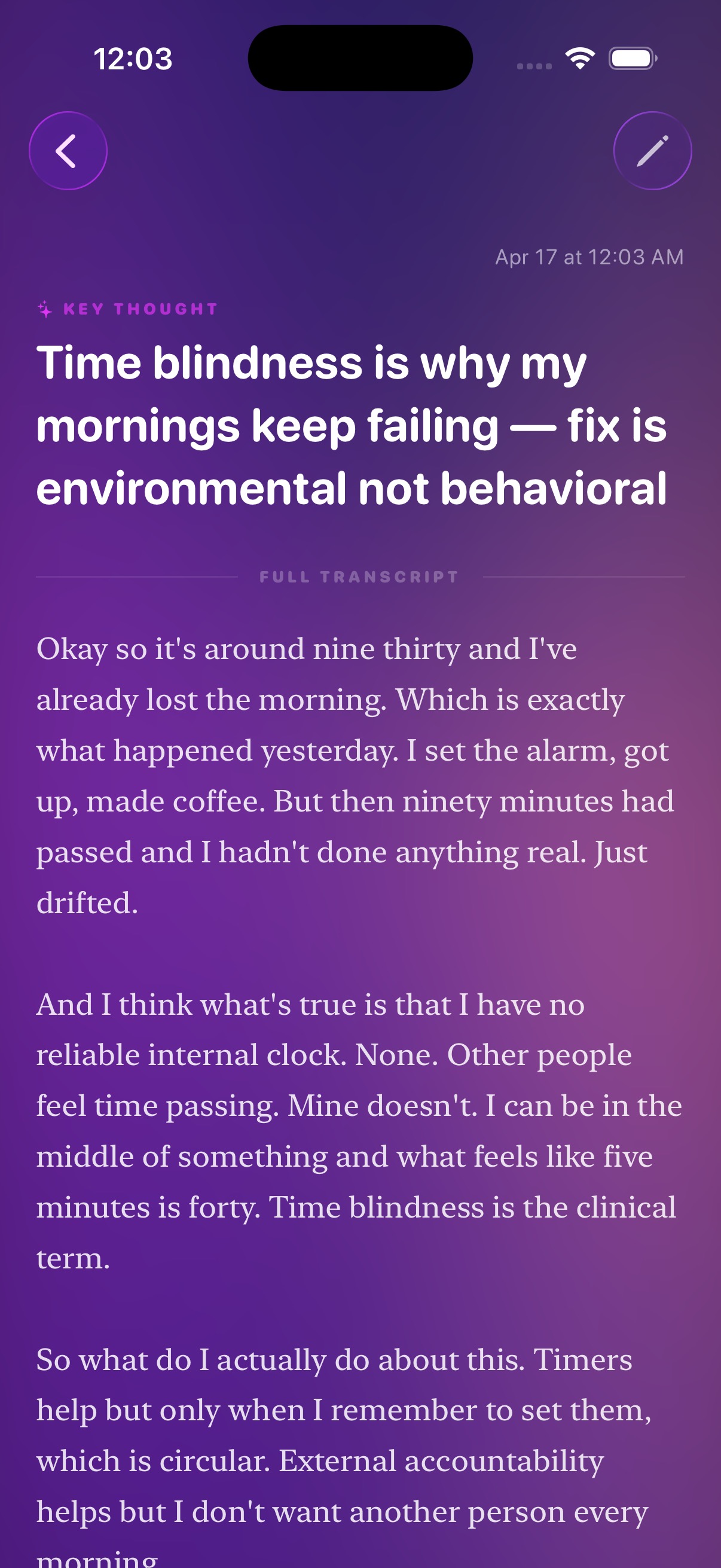
Your thoughts are organized automatically — by theme, emotional signal, what keeps returning. No categories. No homework.
Lisner understands you in the language your thoughts actually arrive in. No translation. No switching. No cognitive overhead.
Everything stays private on your device by default. You choose what to share, with whom, and you can change your mind at any moment.
Privacy isn't a feature. It's the foundation — because a tool for mental health that isn't radically private isn't a tool.
No passive collection. Lisner only captures what you actively choose to record. Nothing runs in the background — ever.
Your voice never leaves your device. Nothing is sent anywhere until you decide to share it. Your therapist only sees what you choose.
You control what's shared. If you ever want to share a thought with someone you trust — it's your choice. And you can change your mind instantly.
Delete is permanent. When you delete a thought, it's gone — from your device, from everywhere. No soft deletes. No cloud backup we're keeping.
One tap sends them a note with everything they need to get started.
Lisner is being shaped in active collaboration with licensed clinicians across ADHD, anxiety, depression, trauma, and bipolar specialties. Early design partners have direct input on what the product becomes — before it reaches the world.
The highest-volume conditions in outpatient mental health. Design partners are actively reviewing the product for clinical accuracy and real-world fit.
Conditions where between-session blind spots carry the highest clinical risk. Advisory focus: safety, accuracy, and clinical trust.
Advisory members have direct input on design, clinical accuracy, and privacy model — before the first public release.